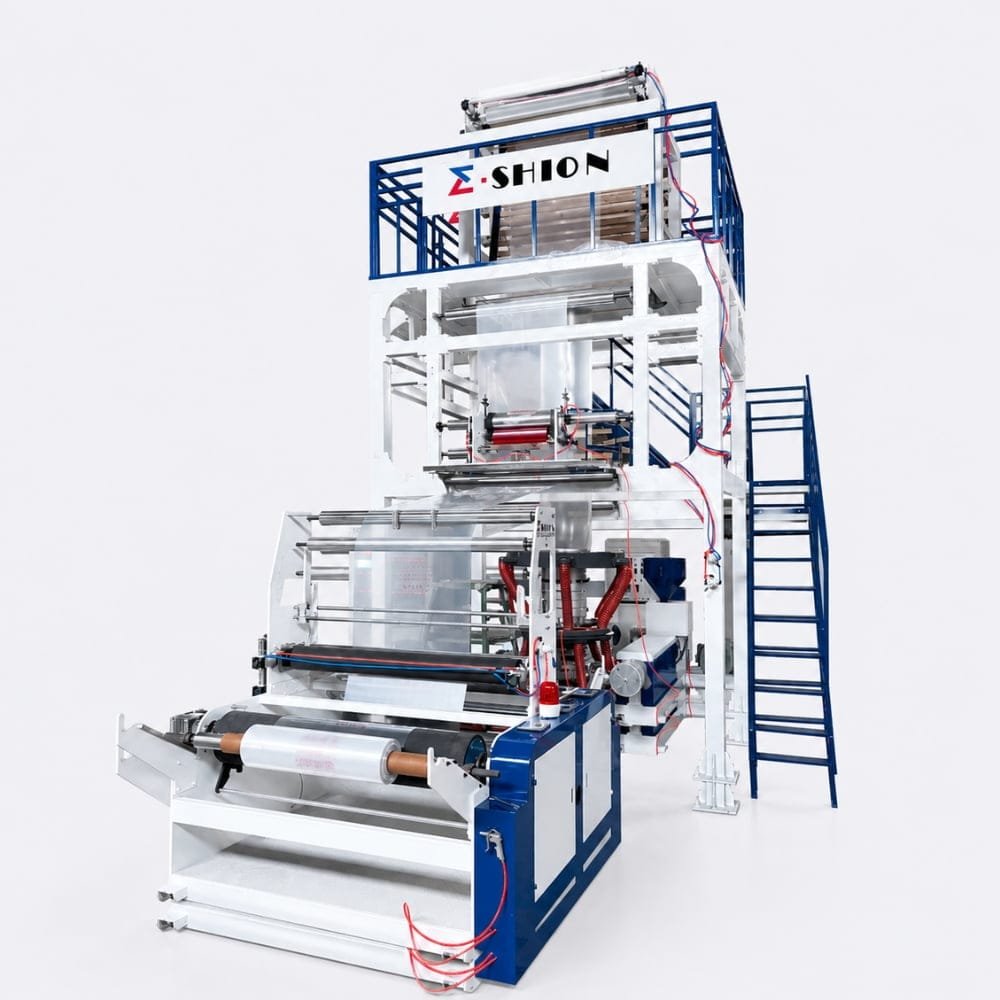
What each line is built for
Mono-layer SJ series extruders are built for standard, single-material film production. They handle folded widths up to 1200 mm and produce film thicknesses ranging from 0.008 to 0.12 mm. Coextrusion lines serve more complex structural needs. ABA lines process LDPE, LLDPE, and HDPE, specifically offering CaCO3 masterbatch options for material modification. The IBC 3-layer SJ-3 is engineered for large-scale production with folded widths up to 2600 mm. Structurally, A/B/A configurations are built to improve bag strength, while A/B/C setups add barrier or cost-control layers.
Cost and output comparison
The mono-layer SJ series delivers outputs between 30 and 120 kg/h. ABA lines match this general capacity range at 40 to 120 kg/h. For high-capacity needs, the IBC 3-layer SJ-3 reaches up to 500 kg/h, producing films from 0.025 to 0.15 mm thick while maintaining a strict thickness tolerance of ≤ ±5%.
When coextrusion pays off
Coextrusion becomes the necessary choice when specific mechanical or economic targets must be met. A/B/A structures improve bag strength directly without altering the base resin. A/B/C structures allow producers to introduce barrier layers for extended product protection or cost-control layers to reduce expensive raw material usage. The IBC 3-layer SJ-3 pays off in wide-format, high-volume runs where the ≤ ±5% tolerance ensures consistent material distribution and minimizes production waste.
Decision checklist
First, define your maximum folded width requirement: 1200 mm for mono-layer and ABA lines, or 2600 mm for the IBC 3-layer SJ-3. Second, calculate your required hourly output, ranging from 30–120 kg/h for smaller lines up to 500 kg/h for the IBC system. Third, identify your material strategy: single resin, CaCO3 masterbatch integration, or multi-layer barrier and cost-control formulations. Finally, verify your thickness tolerance requirements to determine if the ≤ ±5% precision of the 3-layer line is necessary. Confirm specific thickness parameters for ABA lines with our engineers if your application requires exact micron-level control.
| Line Type | Output (kg/h) | Folded Width (mm) | Film Thickness (mm) |
|---|---|---|---|
| Mono-layer SJ series | 30–120 | up to 1200 | 0.008–0.12 |
| ABA lines | 40–120 | 100–1200 | confirm with our engineers |
| IBC 3-layer SJ-3 | up to 500 | up to 2600 | 0.025–0.15 |
Frequently asked questions
What is the maximum folded width and thickness range for the mono-layer SJ series?
The mono-layer SJ series handles folded widths up to 1200 mm and produces film thicknesses ranging from 0.008 to 0.12 mm.
Which line type allows for the integration of CaCO3 masterbatch, and what is its output capacity?
ABA lines process LDPE, LLDPE, and HDPE with CaCO3 masterbatch options, delivering an output capacity of 40 to 120 kg/h.
How do A/B/A and A/B/C coextrusion structures differ in their functional benefits?
A/B/A structures are built to improve bag strength, whereas A/B/C structures add barrier or cost-control layers to the final film product.
What specific thickness tolerance does the IBC 3-layer SJ-3 maintain during high-volume production?
The IBC 3-layer SJ-3 maintains a strict thickness tolerance of ≤ ±5% while producing films from 0.025 to 0.15 mm thick.
Get your custom solution
Talk to our
engineering team
Send your material, sizes and output target — our engineers reply within 4 hours on business days.
Send Your Inquiry →