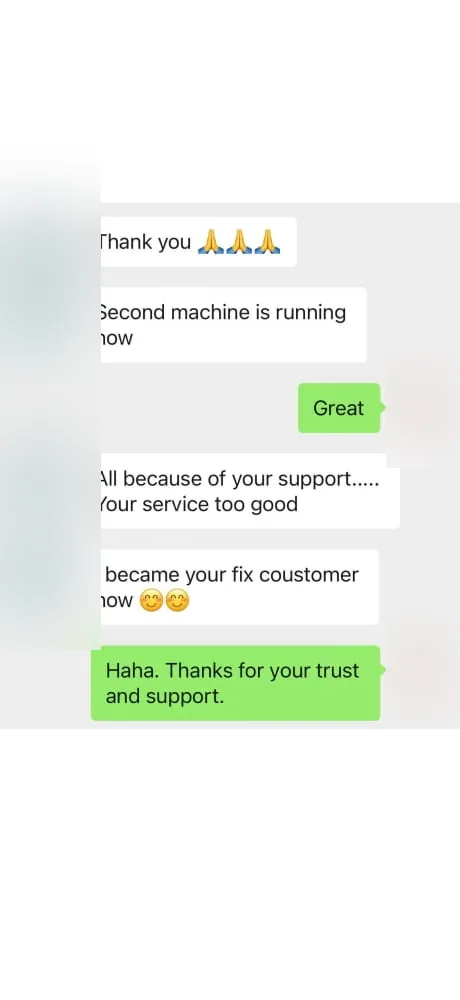
“Our second machine is running now. All because of your support — your service is too good. I became your fixed customer now.”
— Repeat buyer, second order
Home/Machines/Bag Making Machines/T-Shirt Bag Making Machines
Subcategory · Retail carrier bags
Convert HDPE or LDPE film into punched T-shirt bags in one automatic pass — sealing, cutting, handle punching and stacking. E-SHION builds single-frame machines from two to six lanes, sized for new bag plants and existing film converters.
Definition
A T-shirt bag machine feeds film from a roll, seals the bottom of each bag, hot-cuts it to length, punches the carry handles and stacks the finished bags automatically. Photocell registration keeps printed bags aligned to the print mark. The same frame can run HDPE or LDPE, and lane count decides how many bags are produced per cycle.
Specifications
| Parameter | Details |
|---|---|
| Bag width | 550 – 1,150 mm (GFQ-600/800/1000/1200) · 180 – 320 mm × 2 (DFR-400×2) |
| Bag length | 700 – 1,800 mm (GFQ) · 280 – 650 mm × 2 (DFR-400×2) |
| Speed | (60–120) × 2 up to (60–120) × 4/6 bags/min (GFQ) · 100–300 bags/min × 2 (DFR-400×2) |
| Film thickness | 0.01 – 0.15 mm (GFQ) · 0.01 – 0.05 mm (DFR-400×2) |
| Materials | HDPE / LDPE |
| Standard features | Servo drive · photocell registration · automatic punching · automatic stacking |
Selection guide
| Bag type | Sealing / cutting | Machine type | E-SHION model |
|---|---|---|---|
| T-shirt / vest bag | Bottom seal + hot cut + handle punch | Multi-lane bottom-seal machine | GFQ-600/800/1000/1200 |
| Small thin-film vest bag | Bottom seal + hot cut + handle punch | Compact dual-lane machine | DFR-400×2 |
How to choose
Set width, length and film thickness. HDPE gives a stiffer bag; LDPE is softer and more flexible.
Two-lane machines suit smaller volumes; four- or six-lane frames multiply output per minute for high-volume producers.
In-line flexo printing, photocell registration, punch shape and stacking or packing table.
Machines in this subcategory
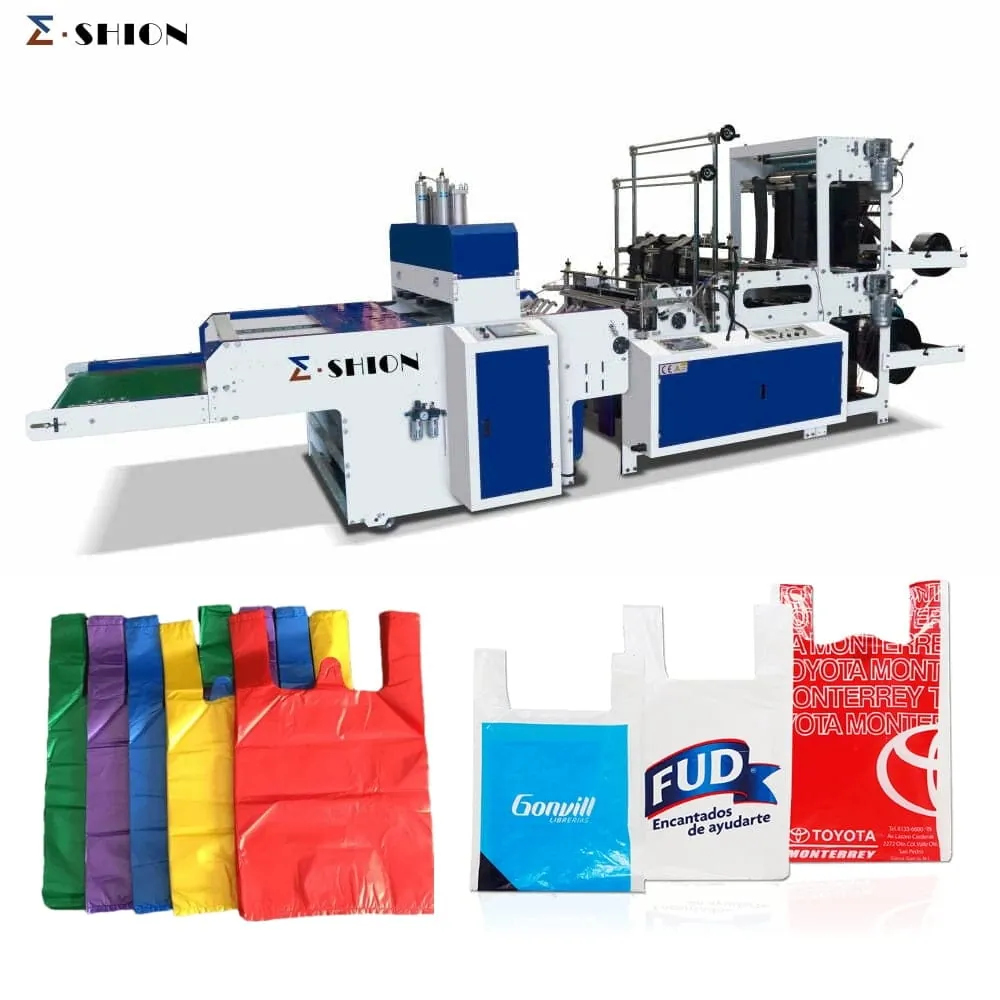
Up to four or six lanes on one frame with 550–1,150 mm bag width — a practical step-up line for mid-volume to high-volume carrier bag production.
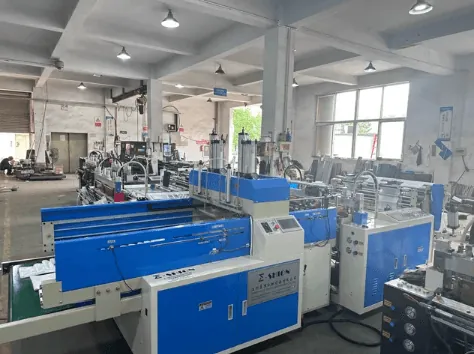
Compact dual-lane model for thin film (0.01–0.05 mm) at 100–300 bags/min per lane — a good starting configuration for smaller plants.
Applications
Vest bags for supermarkets, shops and food markets.
Thin HDPE bags for fruit, vegetables and bulk products.
Carrier bags for food delivery, pharmacies and retail chains.
Film-to-bag producers adding a second line without changing their film source.
For the complete film-to-bag flow, see the T-Shirt Bag Production Line — from film blowing and printing to bag making and recycling.
Buyers ask
The GFQ series runs HDPE and LDPE film from 0.01 to 0.15 mm; the DFR-400×2 is set up for thin film from 0.01 to 0.05 mm.
GFQ models make bags 550–1,150 mm wide and 700–1,800 mm long. The dual-lane DFR makes bags 180–320 mm wide and 280–650 mm long per lane.
GFQ frames run (60–120) bags per minute per lane, from two to six lanes. The DFR-400×2 cuts 100–300 bags/min per lane.
Yes — photocell registration aligns each bag to the print mark, and flexo presses can be added in line.
Handle punch shapes, automatic stacking, packing tables, in-line flexo printing and custom bag sizes are configured on request.
Why choose E-SHION
Our machines are CE certified (LVD, MD and EMC directives) for export to the EEA.
Built in Ruian, Wenzhou — you talk to the factory, not a trading company.
Size, lane count, sealing, punching and printing options are configured on request.
Made-in-China verified supplier with a TÜV audit report, plus CCPIT certification.
Send your bag size and target output — our engineers reply within 4 hours on business days.
Customer voices
— Repeat buyer, second order
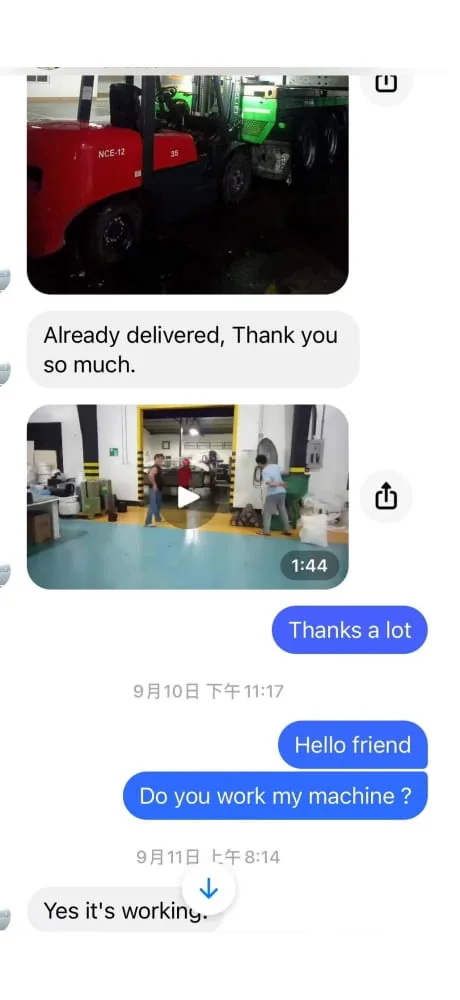
— First-time buyer after delivery
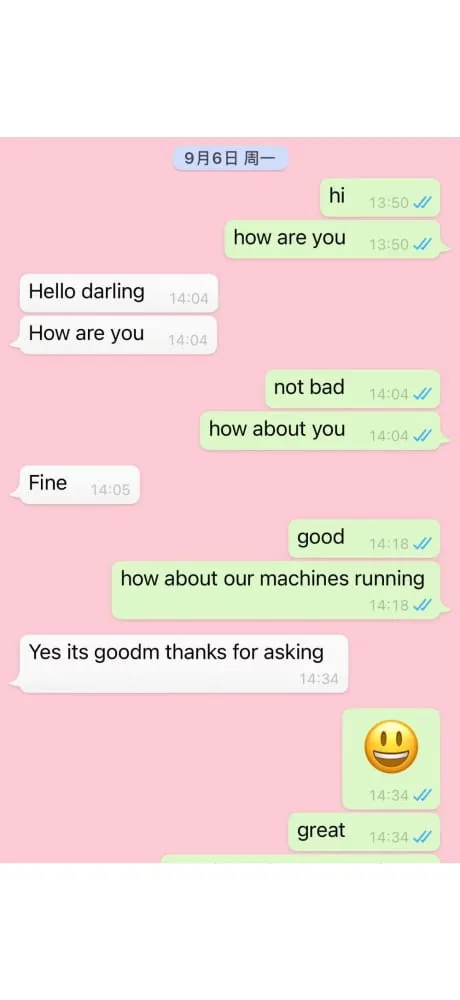
— Existing customer, follow-up visit
Get your custom solution
Tell our engineering team your bag type, size and output target. We design and build machinery to match — average response time 4 hours.
Send Your Inquiry →