Why drawstring bags are different
Drawstring garbage bags require specific manufacturing steps compared to standard flat or star-sealed bags. The primary difference in the production process is that drawstring bags need the drawstring fed and sealed in line before winding. This additional in-line process ensures the closure mechanism is fully integrated and secure before the final roll is formed. Standard bag machines do not have this integrated feeding and sealing capability. If your production line requires modifications for different drawstring types, confirm with our engineers.
The RES-1000 configuration
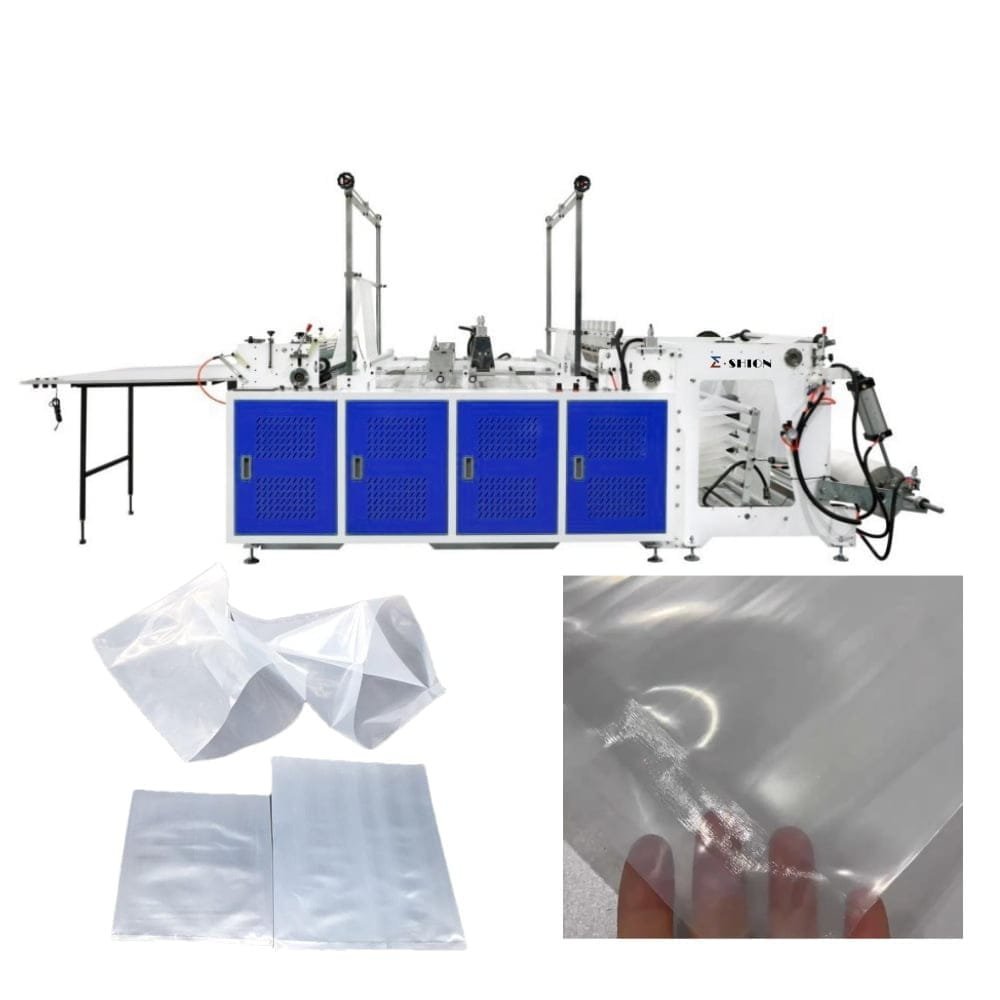
To handle these specific manufacturing requirements, the RES-1000 machine is explicitly designed for producing on-roll drawstring garbage bags. It operates efficiently at a production speed of 70 to 150 pieces per minute. The machine accommodates a maximum bag length of 900 mm and a maximum open width of 800 mm. These dimensions cover a wide range of standard and heavy-duty waste bag sizes. For information regarding custom dimensions or alternative machine models, confirm with our engineers.
Materials: HDPE, LDPE and recycled content
Material selection is critical for garbage bag production. The RES-1000 is configured to process both HDPE and LDPE films, providing flexibility for different strength and elongation requirements. Additionally, garbage bags are a common end product for recycled PE pellets. Utilizing recycled materials in this application is highly effective, as it supports sustainability goals while maintaining the necessary durability for waste containment. If you plan to run specific blends of recycled content, confirm with our engineers to ensure optimal processing.
Printed bags and registration
Branding and product identification are important for retail and commercial distribution. The RES-1000 can process both white and printed film. When producing printed bags, precise alignment is critical for a professional finish. The machine utilizes photocell registration, which keeps printed film aligned on the roll. This ensures that graphics, text, and warning labels remain straight and correctly positioned across every individual bag in the final wound roll. For details on specific ink or film substrate compatibility, confirm with our engineers.
| Parameter | Specification |
|---|---|
| Machine Model | RES-1000 |
| End Product | On-roll drawstring garbage bags |
| Production Speed | 70–150 pcs/min |
| Max Bag Length | 900 mm |
| Max Open Width | 800 mm |
| Compatible Materials | HDPE, LDPE |
Frequently asked questions
What is the production speed of the RES-1000 machine?
The RES-1000 operates at a speed of 70 to 150 pieces per minute for on-roll drawstring garbage bags.
Can the RES-1000 process recycled materials?
Yes, garbage bags are a common end product for recycled PE pellets, and the machine is designed to process HDPE and LDPE films.
How does the machine ensure printed designs are aligned correctly?
The machine uses photocell registration to keep printed film aligned on the roll, ensuring graphics remain straight on every bag.
What are the maximum dimensions for the bags produced on this machine?
The RES-1000 accommodates a maximum bag length of 900 mm and a maximum open width of 800 mm.
Get your custom solution
Talk to our
engineering team
Send your material, sizes and output target — our engineers reply within 4 hours on business days.
Send Your Inquiry →