Start with the film you sell
The machine follows the product, not the other way around. Before looking at machines, write down the films you actually sell: what width are the rolls your customers need, what thickness, and how many tonnes do you produce per day? These three numbers — width, thickness, daily output — determine 90% of the specification.
A film width of 500 mm covers most small workshops making shopping bags. Agricultural film needs wide lines, often 2000 mm and up. High-barrier food packaging adds another requirement entirely: multiple layers co-extruded in one pass. Decide the product first, and the machine list narrows itself.
Width and the die
Film width is set at the die head: a wider die produces wider film, within the physical limits of the tower and winder. The spec sheets on our product pages quote film width (folded) — the layflat width of the final roll. For a 1000 mm folded width, plan on a line in the 1200–1500 mm class.
Buying a wider machine than you need today costs more in capital and energy. Buying narrower than your biggest customer asks for costs you that customer. The safe rule: size for the largest order you already have, not the one you hope for.
Layer count: mono vs co-extrusion
A monolayer line (LDPE or LLDPE) is the cheapest entry point and still the right answer for commodity films. Co-extrusion (3–5 layers) builds barrier and strength properties into the film itself — no lamination downstream — and is what food packaging, heavy-duty bags and shrink film markets increasingly expect.
If your market already asks for barrier film, buy the multi-layer line now. Retrofitting layers onto a mono line later means replacing the die, the extruders and often the tower — it is not an upgrade, it is a new machine.
Output: match the real number
Manufacturers quote output in kg/h. The number that matters to you is tonnes per day, and the honest calculation is output × running hours × efficiency. Nobody runs a line 24 hours a day at 100% — plan on 75–85% for a well-run line.
A 50–120 kg/h mini line produces roughly 1 tonne per day on a single shift. A 300 kg/h line with internal bubble cooling does 5–6 tonnes across two shifts. If your sales target is 100 tonnes a month, size for the peaks, not the average.
The rest of the line matters more than the extruder
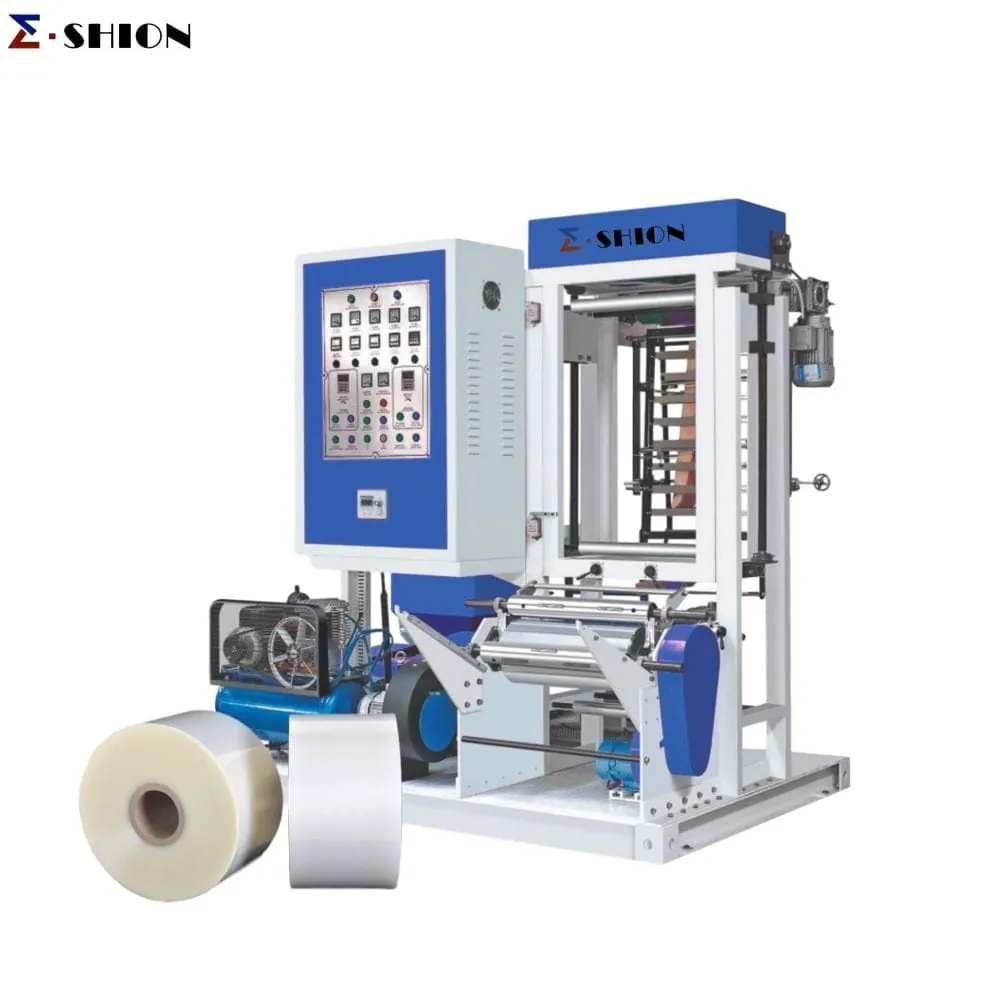
A blown film line is the extruder, the die, the tower, the winder and the controls. Ask what comes with the package: automatic die head adjustment, internal bubble cooling (IBC), online thickness gauging and a tension-controlled winder. These determine film uniformity — and uniformity is what your customers' printing and bag making departments will judge you on.
Every E-SHION line ships with documentation, CE certification and commissioning support. Send us your film width, thickness range and daily output, and we will return a line proposal within 4 hours on business days.
Send us your film specs and output target — we'll size the line for you.
Request a Quote →Get your custom solution
Engineered around
your production
Tell our engineering team your output target and facility conditions. We design and build machinery to match — average response time 4 hours.
Send Your Inquiry →