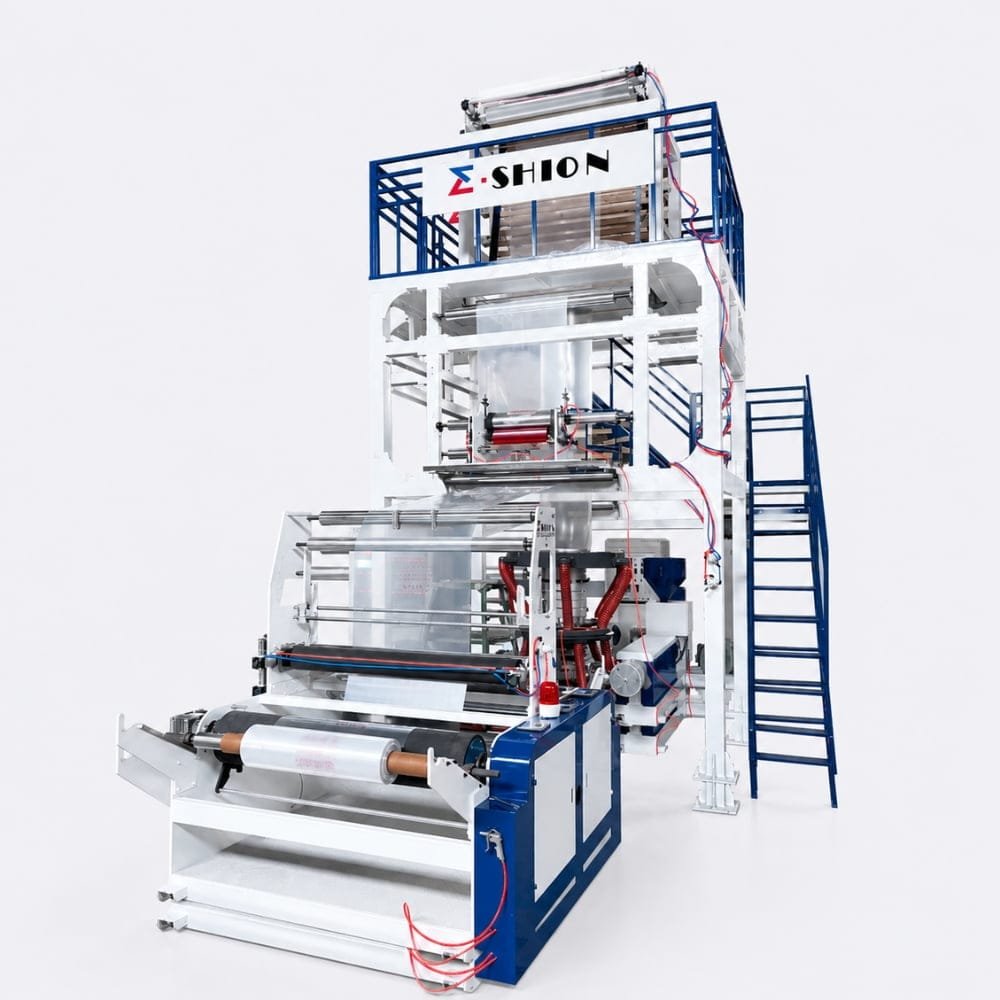
The Formula
Calculating the exact output of a blown film extrusion line is essential for matching production capacity with bag manufacturing demand. The fundamental formula to determine output is: output (kg/h) = film width (m) x thickness (m) x 2 (film tube) x speed (m/h) x resin density (kg/m3).
To use this formula accurately, you must know the resin density in the correct units. HDPE density is approx. 0.95 g/cm3, which converts to 950 kg/m3. LDPE/LLDPE density is approx. 0.92 g/cm3, converting to 920 kg/m3. Plugging these values into the equation allows you to calculate the theoretical output based on your specific film dimensions and line speed.
Worked Example with Real Ranges
Consider a scenario where you are running an LDPE/LLDPE resin (920 kg/m3) to produce a film with a width of 1.0 m and a thickness of 0.00005 m (50 microns). If your line speed is set to 150 m/h, the calculation is: 1.0 x 0.00005 x 2 x 150 x 920. This results in an output of 13.8 kg/h.
To achieve higher outputs within the 30–120 kg/h range typical for mid-sized lines, you must increase the film width, thickness, or line speed. For instance, increasing the speed to 400 m/h with the same dimensions yields an output of 36.8 kg/h. This demonstrates how adjusting the variables directly impacts the final production rate.
Matching the Line to Bag Demand
Selecting the right machinery requires aligning the calculated theoretical output with your daily bag production targets. Different machine configurations offer distinct output capabilities to suit various operational scales and product requirements.
For smaller operations, the SJ-FM-45 model provides an output of 35–50 kg/h. Mid-range requirements are typically met by the SJ-50–65, which delivers 30–120 kg/h, or the ABA configuration, offering 40–120 kg/h. For high-volume industrial bag lines, the SJ-3 model is capable of reaching up to 500 kg/h.
What the Factory Must Confirm
While the mathematical formula provides a reliable theoretical baseline, real-world production introduces physical variables that affect the final yield. Actual output depends on resin, gauge and line efficiency.
Because material behavior and mechanical efficiency can shift the final numbers, theoretical calculations should not be the sole basis for capital investment. Always confirm with our engineers to validate the expected output for your specific application and ensure the selected line meets your exact bag demand.
| Machine Model | Output Range (kg/h) |
|---|---|
| SJ-FM-45 | 35–50 |
| SJ-50–65 | 30–120 |
| ABA | 40–120 |
| SJ-3 | up to 500 |
Frequently asked questions
What is the formula to calculate blown film output?
The formula is: output (kg/h) = film width (m) x thickness (m) x 2 (film tube) x speed (m/h) x resin density (kg/m3).
What are the approximate densities for HDPE and LDPE/LLDPE resins?
HDPE density is approx. 0.95 g/cm3, and LDPE/LLDPE density is approx. 0.92 g/cm3.
What is the maximum output range for the SJ-3 machine?
The SJ-3 machine has an output of up to 500 kg/h.
What factors determine the actual output of the blown film line?
Actual output depends on resin, gauge and line efficiency, so you must confirm with our engineers.
Get your custom solution
Talk to our
engineering team
Send your material, sizes and output target — our engineers reply within 4 hours on business days.
Send Your Inquiry →