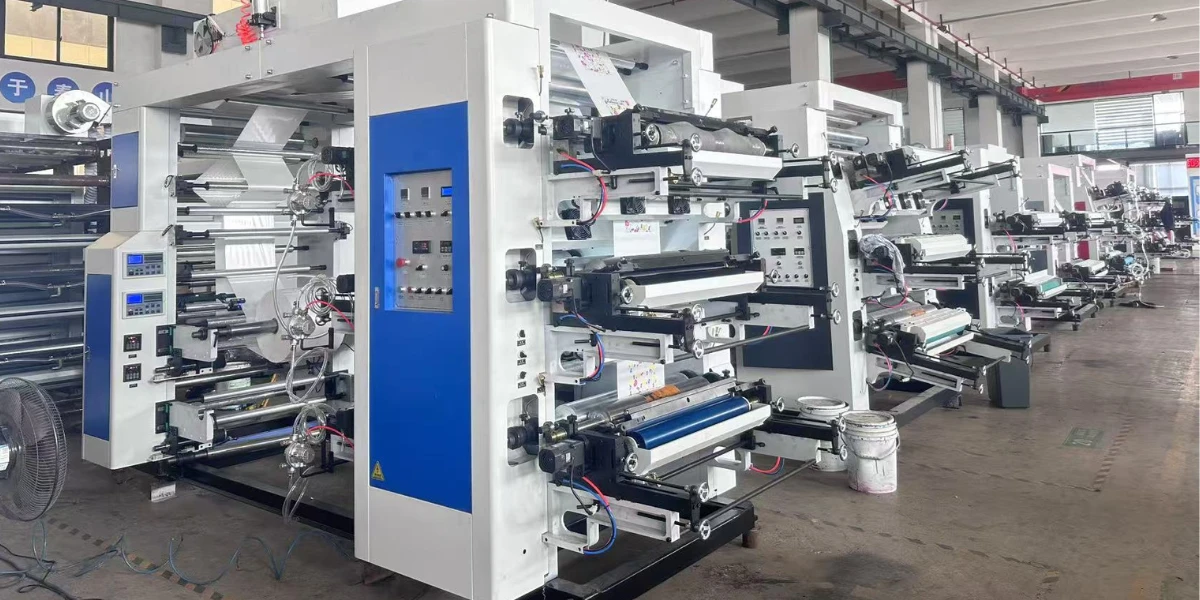
The core difference
The choice between flexographic and gravure printing for plastic bags fundamentally depends on production volume and design complexity. Gravure printing is engineered for long, high-color runs where consistency over massive quantities is critical. In contrast, flexographic printing is optimized for shorter runs and quicker changeovers, offering flexibility for varied packaging designs without the extensive setup times required by gravure. If your specific application requires technical details not covered in this overview, confirm with our engineers.
Flexo: YTL and YTB-A
The flexographic models address varying throughput and color requirements for plastic film. The YTL 41000 is a 4-color flexo press featuring a print width of up to 950 mm. It operates at speeds between 10 and 70 m/min, maintaining an overprint registration of ±0.25 mm. For higher color counts and increased speed, the YTB-A 61000 stack flexo provides 6 colors with the same 950 mm maximum width. This model runs at 10 to 120 m/min, depending on the material, and achieves a tighter ±0.2 mm registration. It also utilizes ceramic anilox rollers for precise ink transfer.
Gravure: ESAY-C 1350
For high-volume, complex packaging, the ESAY-C 1350 gravure press provides high-speed output. It supports 8 colors and handles a maximum web width of 1300 mm, accommodating cylinder lengths from 450 to 1350 mm. The machine achieves a printing speed of 150 m/min, with a maximum mechanical speed of 170 m/min. To ensure absolute precision on long runs, it features ±0.1 mm auto registration paired with video inspection.
Decision table and rule of thumb
The rule of thumb is straightforward: select gravure for long, high-color runs, and choose flexo for shorter runs requiring quicker changeovers. The following table summarizes the technical specifications to aid your decision.
| Specification | Flexo (YTL 41000 / YTB-A 61000) | Gravure (ESAY-C 1350) |
|---|---|---|
| Colors | 4 to 6 | 8 |
| Max Print/Web Width | 950 mm | 1300 mm |
| Max Speed | 120 m/min (material-dependent) | 150 m/min (170 mechanical) |
| Registration Accuracy | ±0.25 mm to ±0.2 mm | ±0.1 mm |
| Ideal Application | Shorter runs, quick changeovers | Long, high-color runs |
Frequently asked questions
What is the primary operational difference between flexo and gravure printing for plastic bags?
The primary difference lies in run length and setup. Gravure suits long, high-color runs where consistency is paramount, while flexo is better suited for shorter runs and quicker changeovers.
What are the speed and registration capabilities of the YTB-A 61000 stack flexo?
The YTB-A 61000 stack flexo runs at 10 to 120 m/min, depending on the material. It achieves a tight ±0.2 mm registration and utilizes ceramic anilox rollers for precise ink transfer.
How does the ESAY-C 1350 gravure press ensure precision during high-speed production?
The ESAY-C 1350 ensures precision during its 150 m/min printing speed by featuring ±0.1 mm auto registration paired with continuous video inspection.
What is the maximum web width and cylinder length supported by the ESAY-C 1350?
The ESAY-C 1350 handles a maximum web width of 1300 mm and accommodates cylinder lengths ranging from 450 to 1350 mm.
Get your custom solution
Talk to our
engineering team
Send your material, sizes and output target — our engineers reply within 4 hours on business days.
Send Your Inquiry →