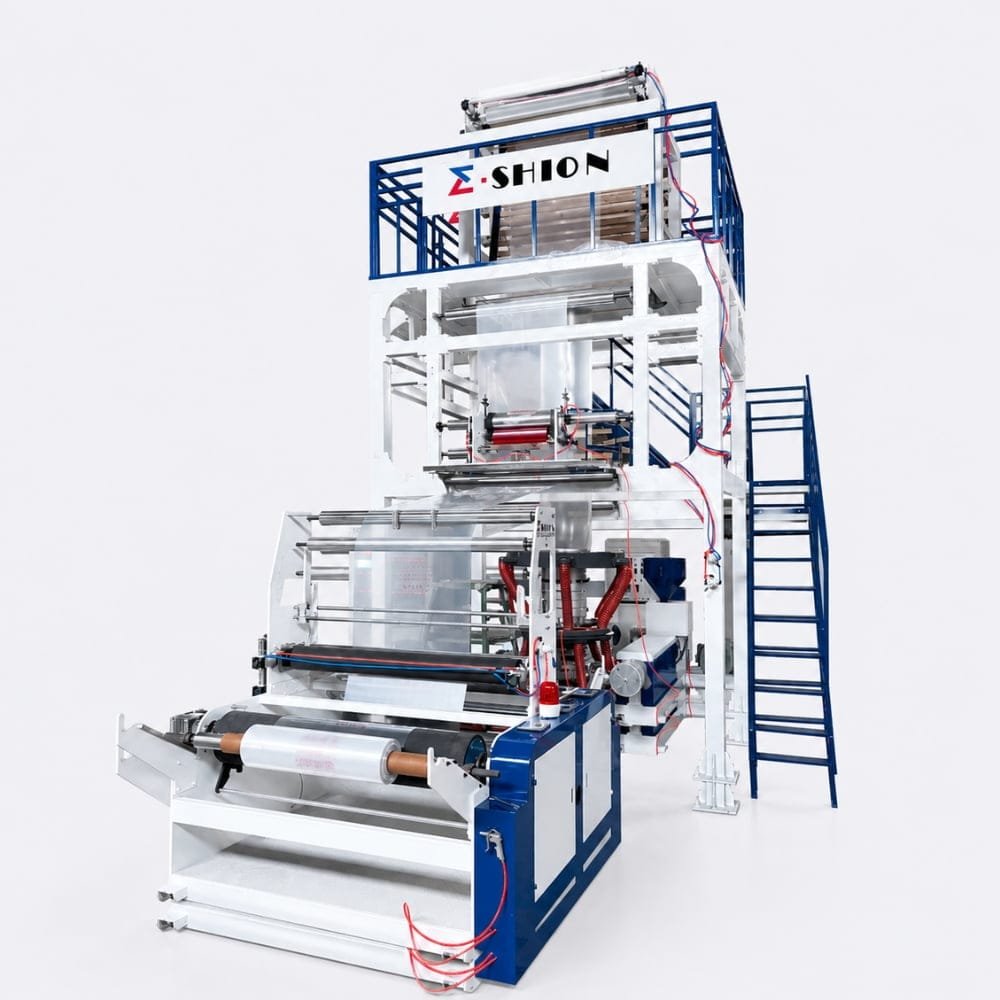
What a blown film extruder actually does
A blown film extruder melts plastic pellets and inflates them into a continuous tube of film. The tube is cooled, flattened and wound into a roll — this one line turns raw polymer into the film used for bags, packaging, lamination and agriculture.
The whole process happens in one machine line: the extruder melts the material, the die shapes it, the air ring and internal cooling stabilize the bubble, and the haul-off and winder produce a clean roll.
Step 1 — melting and mixing
Polymer pellets are fed into a screw extruder. The screw compresses, melts and mixes the material as it travels through a heated barrel. Two numbers matter here: the screw diameter and the L/D ratio (length to diameter). A 30:1 ratio gives good melting and mixing, which means stable film thickness and fewer gels.
- Multi-zone temperature control keeps each section of the barrel at the right heat.
- Nitrided alloy steel screws resist wear when processing filled or recycled materials.
- Variable-frequency drives let you match screw speed to output and film grade.
Step 2 — the die and the air ring
Molten polymer exits through a circular die. Compressed air from the die center inflates the tube into a bubble, and an air ring blows cooling air around the outside. The die gap and air flow control how thick the film is and how evenly it is distributed around the bubble.
In internal bubble cooling (IBC) machines, cooled air also circulates inside the bubble. This removes heat from both sides, which allows much higher output and better thickness consistency.
Step 3 — internal bubble cooling and stability
IBC systems use variable-frequency fans and ultrasonic sensors to keep the bubble diameter stable. The sensors measure the bubble continuously; the controller adjusts airflow to hold the diameter within a tight tolerance. A stable bubble is what makes film thickness uniform across the full width.
Step 4 — haul-off, collapsing and winding
Above the bubble, the film passes through a collapsing frame, over nip rollers, and onto a winder. The haul-off speed sets the film thickness together with the extrusion output. A good winder keeps constant tension, so rolls are hard, flat and easy to use in the next process — printing or bag making.
Multi-layer co-extrusion: why 3 to 5 layers
Co-extrusion machines feed two or more extruders into one die, producing film with several layers in a single step. Layers let you combine properties that one material cannot provide alone: sealability, strength, barrier and cost.
- ABA structure: two identical outer layers with a different core — common for cost-optimized packaging.
- ABC structure: three different materials for barrier films.
- 3 to 5 layers cover most food, agricultural and industrial film applications.
How to choose the right line
- Film width: folded width defines the machine size.
- Output in kg/h: match it to your daily bag or film demand.
- Number of layers and materials (LDPE, LLDPE, HDPE, PP, EVA).
- Thickness range and tolerance — IBC gives ±5% or better.
- Voltage and frequency for your country: 380V/50Hz, 220V/60Hz or customized.
Frequently asked questions
What materials can a blown film line process?
LDPE, LLDPE, HDPE, PP and EVA, in blends or as separate layers. Recycled material can be used in middle layers.
What film thickness can it produce?
Typical lines run from 0.01 mm to 0.15 mm depending on the die and screw configuration.
How much floor space does a line need?
A complete line with a 14 m tower needs roughly 12.5 m × 8.5 m of floor space plus service area.
Can the line be adapted to my voltage?
Yes. Machines are built for 380V/50Hz, 220V/60Hz or customized voltage and frequency for your market.
Do you provide installation and training?
Yes, commissioning and operator training can be arranged, and spare parts are supplied with the line.
Not sure which machine fits your output? Send us your target — our engineers reply within one business day.
Send Inquiry →Get your custom solution
Engineered around
your production
Tell our engineering team your output target and facility conditions. We design and build machinery to match — average response time 4 hours.
Send Your Inquiry →